



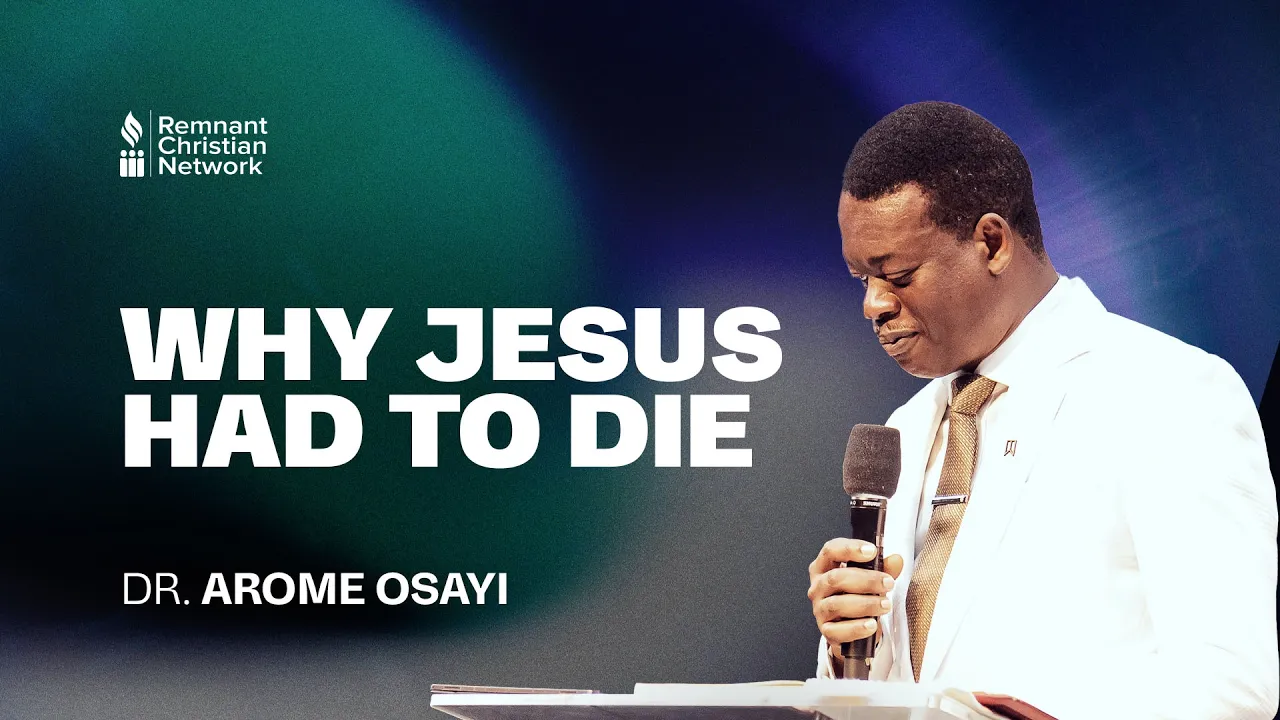
Why Jesus Had To Die by Apostle Arome Osayi: MP3 Download & Sermon Notes
He Died So God Could Rule Earth
lightbulb Message Summary - Key Nuggets
- Until Jesus died and rose, God's authority was confined to heaven — the cross extended his throne to earth.
- Jesus' death was not matter; it was sacrifice — he offered himself willingly as a lamb, without complaint.
- The resurrection emptied paradise, dethroned the prince of this world, and opened heaven to all who believe.
Notes/Excerpt
These notes were taken while listening and may contain some errors. Please tap any sentence twice to suggest corrections.
By holding or selecting a paragraph, you can easily share snippets to friends or on your whatsapp status directly
When the Greeks Came — A Signal in the Spirit
In John 12:20-21, certain Greeks came to the feast with one hidden agenda: they wanted to see Jesus. This was significant. Jesus' ministry had transcended the boundaries of Israel and become international. His relevance had traveled beyond the confines of the Jewish nation.
The moment Jesus received the intelligence that Greeks — Gentiles — had traveled to seek him, something stirred in his spirit. He answered: "The hour is come that the Son of Man should be glorified."
This connection only makes sense when you understand the covenant framework. In the book of Genesis, God made a covenant with Abraham that was explicitly global in scope: "In thee shall all the families of the earth be blessed." According to the theological argument of Paul in Galatians 3, that covenant was made not only with Abraham but with his seed — singular, not plural — which was Christ. Until Jesus came, the Abrahamic covenant operated as though it were exclusively Israeli. The moment Greeks began seeking Jesus, it was a signal that the second, global dimension of that covenant was about to be activated. And for that to happen, Jesus would need to be glorified — which meant he would need to die.
The Abiding Alone Syndrome
John 12:24: "Verily, verily, I say unto you, except a corn of wheat fall into the ground and die, it abideth alone — but if it die, it bringeth forth much fruit."
Jesus is the seed. When a seed falls into the earth, soil water soaks it and causes it to bloat. Soil minerals react with its outer coating, and the seed appears to die. Everything in the seed that can die will die. But the vital life force within it springs forth — and in that springing, multiplication is possible.
notifications_active Stay Updated
Join the Readsermons communities for daily nuggets and new sermon alerts.
Jesus described this as the abiding alone syndrome. As long as he remained only one man on earth, the scope of what God could do through him was limited. The father was not interested in one fruitful seed; he was interested in many sons. Romans 8:29: "For whom he did foreknow, he also did predestinate to be conformed to the image of his Son, that he might be the firstborn among many brethren." Jesus is the prototype. Jesus is the pattern man — the idea of the kind of son God had in mind when he said, "Let us make man." Jesus would need to be cast into the ground so that the abiding alone syndrome could cease.
What Jesus Felt — The Soul Stirred
In John 12:27, the Holy Spirit in the heart of Jesus was stirred. The scripture says: "Now is my soul troubled."
This is one of the kinds of spiritual stirrings the Holy Spirit brings — not cognitive, not emotional in the ordinary sense, but a signal from the spirit. There are different kinds of stirrings: rejoicing, peace, urgency, burden. This particular stirring was the equivalent of spiritual labor — the kind of inner travail that comes when something monumental is approaching in the realm of the spirit.
This trouble was not random. It was the Holy Spirit communicating that the hour had come for him to be cast into the ground. What did Jesus do? He prayed: "Father, glorify thy name." And from heaven came a voice: "I have both glorified it and will glorify it again."
The context matters. We are in chapter 12. In chapter 11, Lazarus had just been raised from the dead. God was effectively saying to his Son: just as I raised Lazarus through you, I will raise you. This was the underground, foundational work of intimate exchange between the Father and the Son that made it possible for Jesus to face the death he was ordained to die. God was not abandoning him. The Father was making a promise.
Governmental Displacement — John 12:31-32
Jesus then made a statement for his audience: "Now is the judgment of this world. Now the prince of this world is cast out. And if I be lifted up from the earth, I will draw all men unto me."
Apostle Arome Osayi
Enjoying this sermon? Browse more messages by Apostle Arome Osayi on The Cross at ReadSermons.
This is governmental displacement. The prince of this world was to be deposed, and because there can be no vacuum in the realm of the spirit, a replacement would come. That replacement — and the displacement — was what the cross would accomplish.
To understand the depth of this, consider Ezra 1. When Cyrus, king of Persia, made his proclamation, he called God "the God of heaven." Not the God of earth. God was recognized in that era as the God of heaven — his power and omnipotence limited to the heavenly realm. He had no authority on earth because by royal decree in Psalm 115:16, the earth had been given to the sons of men. God himself could not violate that decree. He was compelled to work through human authority — which is why he stirred the spirit of Cyrus to implement his purposes. The problem that confined him to heaven needed to be solved. The cross was the solution.
When Jesus was crucified, Pilate wrote the reason in three languages — Hebrew, Greek, and Latin — the three languages of literacy in the known world. "Jesus of Nazareth, the King of the Jews." The chief priests protested; they wanted it to say he claimed to be king, not that he was. Pilate answered: "What I have written I have written." The title stood. The reason for which he was being crucified was that the kingdom of heaven might become effective, potent, and efficacious upon the face of the earth — so that God would no longer be called merely the God of heaven, but the God of heaven and earth.
Psalm 22 — The Script of the Cross
Psalm 22:1: "My God, my God, why hast thou forsaken me?" These were the very words Jesus spoke at a critical moment on the cross — not throughout, but at the moment when the transactions of redemption were at their height.
The Father is called the Triholy God, whose eyes are not adjusted to behold iniquity. The moment Jesus became sin — and all of sin in all its definitions, expressions, powers, and possibilities was placed upon him — the Father had to turn his face away. In the history of God, Father and Son had never been separated. So the Father communicated his grief through a sign: he tore the veil of the temple from top to bottom. Curtains fray from the bottom; the Father had to tear his from the top. It was a sign that he was in mourning. He was not abandoning his Son — he was grieving the separation, just as deeply as his Son was experiencing it.
Jesus did not complain about what men did to him. When the scourge came, he opened not his mouth. When the crown of thorns was placed, he opened not his mouth. When he bore the cross and fell repeatedly, he opened not his mouth. Because a sacrifice must be offered willingly — a lamb before its shearer is dumb. The only time he cried out was to his Father: "My God, my God, why hast thou forsaken me?"
You may also like
Efc2026: Easter Faith Convention - Wings Of Faith - Hour Of Visitation
by Bishop David Oyedepo
Did God answer? Yes. The third omen — the torn veil — was his answer. An omen is non-cognitive communication. God chose the temple to send a signal that only the spiritually attuned could read: the one between the cherubim was in mourning.
Jump to Psalm 22:24: "For he hath not despised nor abhorred the affliction of the afflicted — neither hath he hid his face from him — but when he cried unto him, he heard." God heard. The separation was real, but the rejection was not permanent. And the consequence: Psalm 22:27: "All the ends of the world shall remember and turn unto the Lord, and all the kindreds of the nations shall worship before him." This was the fulfillment of John 12:32 — he would draw all nations to himself.
The Report of Isaiah 53 — How Salvation Was Procured
Isaiah 53 is the soul of the book Isaiah — what theologians call the fifth gospel. It opens: "Who hath believed our report?" There is a report to believe. And the report is this:
- He had no form nor comeliness — there was no beauty that men should desire him
- He was despised and rejected of men — a man of sorrows, acquainted with grief
- He grew like a root that sprang out of dry ground — everything worked against him, yet he kept moving by faith
- Surely he hath borne our griefs and carried our sorrows — yet men esteemed him stricken, smitten of God
- He was wounded for our transgressions — bruised for our iniquities — the chastisement of our peace was upon him
- With his stripes we were healed
This is how salvation was procured — with grief, with rejection, with sorrow. The shape of the cross should shape expectations. The average believer in this generation wants to believe that the only thing in Christianity is to prosper and do well. But we have not understood our foundation. The path of our salvation involved suffering — and so will the path of our service.
He was a lamb before its shearer. He opened not his mouth. He went to his death not as matter but as sacrifice — willingly, for a purpose larger than himself.
What Was He Hoping to Gain?
Here is the question that must be answered: what was Jesus hoping to gain from the cross?
The answer is: nothing for himself. His sacrifice, if it had been found with spot by the court of heaven, would have meant no resurrection. He offered himself through the eternal Spirit without spot unto God (Hebrews 9:14) — and that offering was evaluated. The Holy Spirit helped him offer himself so that the offering would meet the mark of divine justice. It took three days in the underworld for the court of heaven to evaluate the weight of his blood against the weight of sin on the beam balance of justice, judgment, and equity. When the evaluation was complete, the resurrection was authorized.
It is in salvation that you gain. It is in consecration that he begins to gain. And the question that must confront every believer is: how much have you allowed him to gain from your life?
He must gain. He must gain in every nation and every generation. Your rank in eternity will be measured by how much he was able to gain through your life.
Apostle Arome Osayi
Enjoyed this sermon? Browse more messages by Apostle Arome Osayi on ReadSermons.
Comments
0 comments
No comments yet. Be the first to share.
Stay updated with Readsermons
To be notified on every sermon release, join the group that suits you best:
For nuggets & Sharable snippets follow us.
headphones Media & Resources
Listen to Sermon
Download initiated! Follow us to be the first to get new sermons by Apostle Arome Osayi.
Why Jesus Had To Die
Apostle Arome Osayi • 41MB
Download initiated! Follow us to be the first to get new sermons by Apostle Arome Osayi.
Your download
is starting! 🎉
Connect with us directly for more powerful teachings.
Why Jesus Had To Die
00:00:00 / 00:00:00