




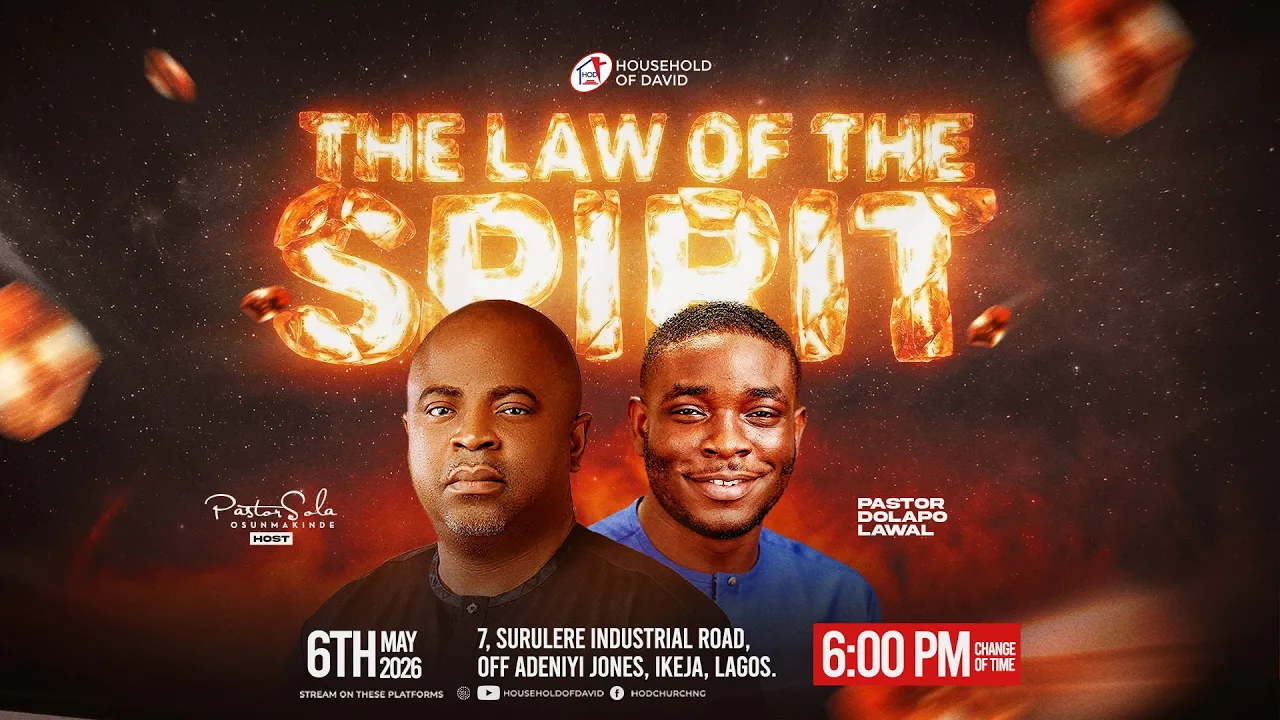
The Law Of The Spirit by Pastor Dolapo Lawal: MP3 Download & Sermon Notes
Everybody's Word Is Custom Made
lightbulb Message Summary - Key Nuggets
- Five distinct laws appear in Scripture — distinguishing them is foundational to Christian living.
- The law of sin and death governs fallen human nature through deep-seated programming, not mere habit.
- Only a quickened, personalised word from God can override the law of sin and death.
- Christ fulfilled the ceremonial law; the Spirit now writes God's moral standard inwardly on every believer.
Notes/Excerpt
These notes were taken while listening and may contain some errors. Please tap any sentence twice to suggest corrections.
By holding or selecting a paragraph, you can easily share snippets to friends or on your whatsapp status directly
The Word and the Stories
There is a growing concern in the body of Christ — sermons are being evaluated not by the depth of scripture they carry, but by how many stories they tell. A boring sermon today is any sermon that uses many scriptures.
Paul's method in the epistles was explanation, illustration, and application — in that order. In Romans 1–3, he establishes doctrine. From Romans 4–5, he brings in personalities like Abraham and David as illustrations. Then he moves to application. The problem is that people want to skip to the ending and skip the beginning — but the beginning is the word of God. The ending is wisdom, stories, and application. When people say the doctrine is wearing them out, what they mean is: tell me stories.
Christianity has moved from God himself to what we can get from him. When the woman with the issue of blood is taught, the focus shifts from Jesus to how she received her miracle. The actor is forgotten; only the technique is emphasised.
Five Laws in Scripture
From Romans 8:2, at least five distinct uses of the word 'law' appear in Scripture:
- The word of God — David said, 'Your laws have I hidden in my heart.' The word of God itself functions as law.
- The law of sin and death — the inward pull toward sin described in Romans 8.
- The law of the spirit of life in Christ Jesus — also from Romans 8, confirmed in Galatians 6:2: 'Bear one another's burdens and so fulfil the law of Christ.'
- The law of Moses — a covenant of commandments given to Israel at Sinai.
- The law of God — the eternal moral standard reflecting God's own nature.
notifications_active Stay Updated
Join the Readsermons communities for daily nuggets and new sermon alerts.
Understanding the distinction between these laws is critical. Much confusion in the church comes from conflating them.
The Law of Moses
The law of Moses is a covenant of commandments given to Israel at Sinai — written on stone, demanding but powerless to save. Within it are three categories:
- God's moral laws — the Ten Commandments, which reflect God's own character. God does not murder, does not commit adultery, does not steal. These commandments describe what God himself will not do.
- The ceremonial laws — sacrifices, feasts, clean and unclean foods, priesthood, rituals. All of these were shadows pointing to Christ. Hebrews 10:1 says the law had a shadow of good things to come but not the very image of those things. Colossians 2:16-17 confirms: 'Let no one judge you in food or drink, or regarding a festival or new moon or Sabbath — which are a shadow of things to come, but the substance is Christ.'
- The interpretive laws — Moses added approximately 600 laws as interpretations of the original commandments, on account of the hardness of the people's hearts. For example, God said 'Remember the Sabbath day and keep it holy.' Moses interpreted this as 'You must not walk.' But God said rest — not inactivity. Rest means doing what God said to do. Stress comes from carrying yokes God did not assign. That is why Jesus walked on the Sabbath and healed on the Sabbath. 'My Father works, so I work.'
The ceremonial law was the shadow pointing forward to Christ. In the Old Testament, forgiveness required a blood offering — the sinner brought a lamb to the priest, who examined the offering, not the sinner. If the offering was without blemish, it was accepted. The focus left the man and moved to what he presented. Acceptance before God depended on the quality of the offering.
Pastor Dolapo Lawal
Enjoying this sermon? Browse more messages by Pastor Dolapo Lawal on Law Of The Spirit at ReadSermons.
This is precisely what happened at the cross. It was important that the chief priest moved the crowd to call for Jesus's crucifixion — he was unwittingly fulfilling the ordinance of the law. Mark 15:10-13 records it. The law required priestly involvement. Jesus was the lamb without blemish; the substance of every shadow had arrived. After Christ, the shadows were no longer needed.
Circumcision is another example. Physical circumcision typified the circumcision of the heart. Jeremiah 4:4 commanded, 'Circumcise yourselves to the Lord and take away the foreskins of your hearts.' Philippians 3:3 declares, 'We are the circumcision who worship God in the spirit, rejoice in Christ Jesus, and have no confidence in the flesh.' The physical sign pointed to the spiritual reality that is now fully available in Christ.
The book of the law — Moses's 600 laws — was placed beside the ark of the covenant. The tablets of stone — the Ten Commandments — were inside it. Two different things in two different positions. The one inside is what is called the law of God. The one beside it is the law of Moses.
What Christ redeemed believers from was the ceremonial law — not the Ten Commandments. Remove the Ten Commandments and society collapses. Those commandments are what Adam and Eve broke in the garden — they failed to honour God their Father, they committed idolatry which is adultery in covenant terms, they coveted what was not given to them, they stole from God, and their transgression brought murder and death into the world for all. Ephesians 2:15 says Christ abolished 'the enmity, even the law of commandments contained in ordinances' — that is, the ceremonial and interpretive ordinances, not the moral core.
The Law of God
The law of God — the Ten Commandments — is the eternal moral standard that reflects God's own nature. It is perfect. It is righteous. It is good. But it exposes sin without removing it. It tells you what you shall not do, but it does not tell you how not to do it.
The new covenant promise was never to abolish the Ten Commandments but to internalise them. 'I will write my laws in their inward parts. I will take away the heart of stone and give them a heart of flesh.' What God is writing inside every believer through the Holy Spirit is the very moral law of God — but now powered and fulfilled through the law of the Spirit of life in Christ. In the old covenant there were 610 commandments; in the new covenant there are over 1,045. In the old covenant, they slapped you and you could slap back. In the new, returning the slap is sin. Before the new covenant, keeping malice was not explicitly prohibited by the Ten Commandments. Now, unresolved malice hinders prayer entirely.
The Law of Sin and Death
In Romans 7, Paul described an internal war: 'There is a law in my members such that what I want to do, I don't do. What I don't want to do, I do.' That is the law of sin and death — the ruling principle inside fallen human nature. It is the inward pull toward sin that produces guilt, bondage, and ultimately death.
You may also like
Purpose Of Kingdom Wealth
by Pastor Philip Olubakin
It operates like deep programming. David is Saul — that is the revelation. God placed David in front of Saul not only for training but because the wickedness David saw in Saul was latent in David too. God was showing David a mirror, so that David would not repeat what he witnessed. But David did not learn the lesson — and despite all his devotion, he killed Uriah. The programming ran deeper than the intention. Saul was wicked to him; David became wicked to someone else.
Anyone struggling with addiction understands this. A man who had lost his family to gambling said: 'If you give me £10 now, I will gamble.' He did not want to gamble. He desired to stop. But he could not. That is the law of sin and death — it is not about willpower. It is about programming that has been built into the members through repetition and exposure.
Freedom is not being free to start. Real freedom is being free to stop.
God presented the children of Israel with life and death in the wilderness and urged them to choose life. But their programming was Egypt. They could declare they wanted the Promised Land — yet at the first difficulty, they wept for the food of Egypt. The law of sin and death makes a person desire one thing and do another.
The Law of the Spirit of Life in Christ
The law of the spirit of life in Christ is the governing principle that overrides the law of sin and death. It is not a technique — it is a living dynamic rooted in a living relationship with Christ.
Two men struggled with the same addiction. The same counsel was given to both: when the urge comes, sing worship songs and involve God in the moment. The first man returned weeks later completely changed — every time the urge arose and he worshipped, it lifted. The second man returned worse than before. He had even stopped mid-worship and acted on the urge. Why the difference? For the first man, the word was quickened — it became spirit and life, a custom-fit word from the Holy Spirit. For the second man, it was a borrowed word — it was sin and death. A word that has not been made alive by the Spirit for that person will not produce. You cannot borrow word.
Testimony can seduce. If Abraham's testimony about offering Isaac moves someone to give their last savings — not because God spoke to them but because they desire the result — that is covetousness operating under the law of sin and death. The first person acted in spirit and life through genuine obedience; the second acted in sin and death through coveted imitation. One person got a contract in the hundreds of millions; the other gave and waited years with nothing — then blamed the pastor and declared all preachers are liars. The fault was not the testimony. The fault was borrowing someone else's word.
Delay Versus Process
The law of the Spirit of life enables a person to navigate what looks like delay by recognising it as process. This is the difference between delay and process.
When it is delay, there is shame — you fight it, the enemy presses it, you scramble. When it is process, there is no shame. You coordinate yourself. God inhabits praises. The moment a person murmurs, God checks out and something else checks in.
God called the complaining children of Israel 'this evil congregation' in Numbers 14:27. Their evil was not immorality — it was their complaining. Complaining is identified as evil. It opens the door to what God has closed.
You know you are in process — not delay — when you are without employment yet people can still come to you to borrow. When you have passed through the Red Sea and there is no food yet, the Spirit-and-life response is thanksgiving. The sin-and-death response is murmuring.
Every difficulty in life is presenting the same examination: will you operate under the law of the Spirit of life, or the law of sin and death?
Multitude and Disciples
Multitude eat bread; disciples learn how to multiply bread. The multitude run to prophets for prayer; disciples stay and learn principles.
Even Jesus in Matthew 26 took three people to pray with him — not for him. The disciple brings a battle to a pastor not for seeds and intercession alone, but to ask: 'Do you have a principle I can appropriate?' The law of the spirit of life in Christ is accessed by those who understand the economy of doing it yourself — who receive the principle, personalise it, and walk it out in the Spirit.
Pastor Dolapo Lawal
Enjoyed this sermon? Browse more messages by Pastor Dolapo Lawal on ReadSermons.
Comments
0 comments
No comments yet. Be the first to share.
Stay updated with Readsermons
To be notified on every sermon release, join the group that suits you best:
For nuggets & Sharable snippets follow us.
headphones Media & Resources
Listen to Sermon
Download initiated! Follow us to be the first to get new sermons by Pastor Dolapo Lawal.
The Law Of The Spirit
Pastor Dolapo Lawal • 22MB
Download initiated! Follow us to be the first to get new sermons by Pastor Dolapo Lawal.
Your download
is starting! 🎉
Connect with us directly for more powerful teachings.
The Law Of The Spirit
00:00:00 / 00:00:00