


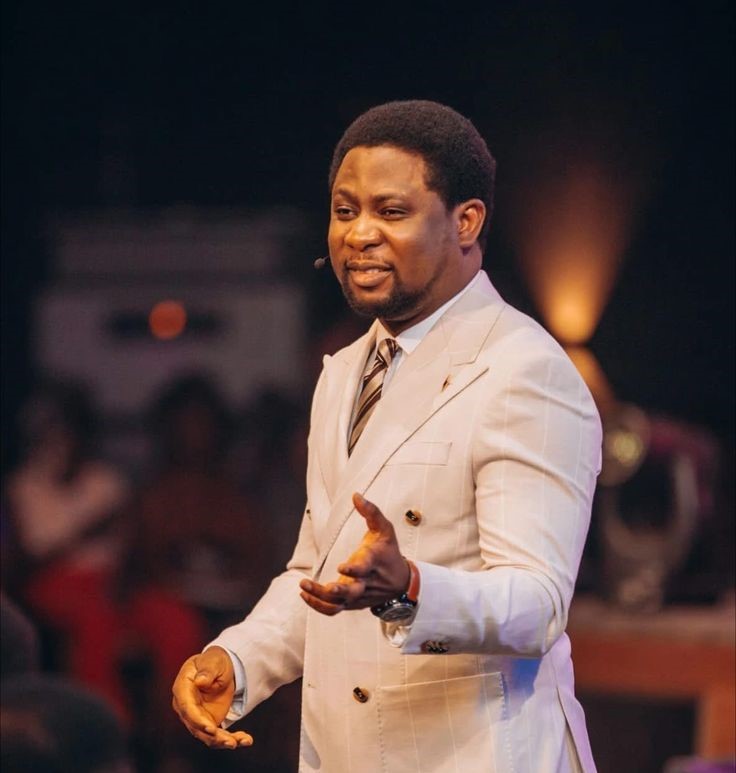
Who Is Jesus? (camp Meeting Session 1) by Pastor Dolapo Lawal: MP3 Download & Sermon Notes
Jesus Is God
Notes/Excerpt
These notes were taken while listening and may contain some errors. Please tap any sentence twice to suggest corrections.
By holding or selecting a paragraph, you can easily share snippets to friends or on your whatsapp status directly
Jesus Is God
Revelation 22:13 — I am the Alpha and the Omega, the beginning and the end, the first and the last. And look at verse 16: I Jesus have sent my angel to testify to you these things in the churches. The one speaking is Jesus — and he is using the exact language God used in Isaiah 44:6 and 44:8 about himself. That claim belongs to Yahweh alone.
Matthew 14:33 — When Jesus walked on water, those in the boat came and worshiped him. He did not stop them. Compare that with Revelation 22:8–9 — when John fell to worship an angel, the angel immediately said: do not do that, worship God. Jesus is not an angel. He is God. The entire structure of Hebrews 1–2 exists to establish this: Jesus is greater than angels, greater than Moses, greater than Joshua.
John 1:6 — There was a man sent from God, whose name was John. Jesus is not a man sent from God. Jesus is God who became man. He is the God who sent the man.
What "Son of God" Actually Means
You understand Bible words from the Bible — you do not import dictionary definitions.
Son of God is used in two ways in scripture. First, it describes direct creations of God. In Genesis 6:2 and Job 1:6, the sons of God who came to present themselves before the Lord were angels — direct creations not born of women. Satan came among them because he too was a direct creation, a fallen angel. Jesus is called Son of God in the same sense — the Holy Spirit overshadowed Mary, and what was born was a direct creation of God, not born of the seed of man. Luke 1:35 — therefore the holy one who is to be born will be called the Son of God.
notifications_active Stay Updated
Join the Readsermons communities for daily nuggets and new sermon alerts.
Second, Son of God refers to the place where divinity and humanity meet. Romans 8:14 — for as many as are led — the Greek word ago means born forth — by the Spirit of God, they are sons of God. John 1:12 — as many as received him, to them he gave power to become sons of God. We are also sons of God in this sense — as those in whom divinity and humanity meet through the new birth.
What "Son of Man" Actually Means
Son of man appears in Ezekiel about 90 times, meaning mortal or human being. But in Daniel 7:13–14, it carries a distinct prophetic weight — one like the Son of Man coming with the clouds of heaven, given dominion and glory and an everlasting kingdom that will not be destroyed.
This is the title Jesus used deliberately. When he said it before the high priest in Mark 14:62, the priest tore his clothes — not because of the human connotation, but because the mind of every Jew in the room went to Daniel 7:13. Son of Man in Jesus's mouth was a Messianic claim. He was saying: I am the one Daniel saw coming with the clouds of heaven.
Why Jesus Prayed on the Cross
If Jesus is God, why was he crying out in John 19? Because he was fulfilling scripture — specifically Psalm 22, which contains his conversation on the cross. Psalm 23 contains his words in the grave — the Lord is my shepherd, I shall not want, though I walk through the valley of the shadow of death. Psalm 24 contains his words at resurrection — lift up your heads, O gates, that the King of glory may come in. He was not praying as a dependent creature. He was setting up the fulfillment of what had been prophesied.
Jesus Is Prophecy Fulfilled
Pastor Dolapo Lawal
Enjoying this sermon? Browse more messages by Pastor Dolapo Lawal on Jesus at ReadSermons.
Jesus and the gospel were not a new idea. There are approximately 55 prophecies covering four areas: his birth, his ministry, his death and resurrection, and his role in the church.
Genesis to Malachi is scripture. The synoptic gospels are the manifestation of what scripture promised. The epistles are an explanation of the fulfillment and its implications.
In the entire New Testament epistles, Jesus is directly quoted only 12 times. The Old Testament is quoted over 300 times. That is the ratio. Jesus did not start a new religion — he came to give their religion its meaning. He told them: if you knew the scriptures, you would have known I am from the Father.
The Gospel Was Preached Before the Cross
Galatians 3:8 — the scripture foreseeing that God would justify the Gentiles by faith preached the gospel to Abraham beforehand: in you all nations shall be blessed. The blessing there is not money. In Genesis 28, after Jacob received the blessing, he saw angels ascending and descending. Esau had more wealth and lost the blessing. The blessing is capacity to fellowship with God — and in your seed shall all nations have that capacity.
Hebrews 11:17–19 — when Abraham offered Isaac, he concluded that God was able to raise him up. That word is resurrection. Abraham, in typology, was believing in the resurrection of Christ. Romans 4:19–22 confirms it — he did not waver, being fully convinced God was able to perform.
Hebrews 4:2 — the gospel was preached to Israel also, but the word did not profit them, not being mixed with faith. Moses in Deuteronomy 30:11–15 was preaching the gospel. Paul quotes it directly in Romans 10:6–9 — do not say who will ascend into heaven, that is to bring Christ down; or who will descend into the abyss, that is to bring Christ up from the dead. The word is near you, in your mouth and in your heart. That is the word of faith we preach. Paul got it from Moses.
You may also like

The Exploits Of A Sent Man (part 3)
by Pastor Jerry Eze
Even Abel heard the gospel. In Genesis 3:21, after the fall, God made tunics of skin and clothed Adam and Eve — the first shedding of blood to cover sin. This established the principle that atonement requires substitutionary death, long before Leviticus made it explicit. Abel heard this from his father. That revelation is why his offering was by faith and Cain's was not. Faith comes by hearing — Abel believed something, and that something was the gospel in shadow.
Key Prophecies
His birth: Isaiah 7:14 — the virgin will conceive and bring forth a son, Emmanuel. Micah 5:2 — he will be born in Bethlehem. Hosea 11:1 — out of Egypt I called my son.
His ministry: Genesis 3:15 — he will crush your head, fulfilled in 1 John 3:8. Isaiah 9:1–2 — where his ministry would begin.
His death: Psalm 31:13 — they plotted to take his life. Psalm 69:21 — his thirst quenched with vinegar and gall. Psalm 22:16–18 — they pierced his hands and feet, they divided his garments.
His resurrection: Hosea 6:2 — after two days he will revive us, on the third day he will raise us up. 1 Corinthians 15:4 — he rose again the third day according to the scriptures. The authenticating phrase is according to the scriptures — meaning Genesis to Malachi.
What This Means for Us
If Jesus is God, then we are not God. But we are called to look like him.
The reason we do not is threefold. First, we justify what God calls sin because it feels right to us. We stop calling it sin and call it a flaw, a weakness, something God understands. Seeing God understands to excuse disobedience is trying to redefine righteousness — and that is sitting in God's seat.
Second, we withhold forgiveness because we feel someone does not deserve it. But forgiveness is obedience, not approval. People do not change for you to forgive. You forgive so you can change. If there is no Judas, there is no cross. If there is no cross, there is no glory. God picked Paul — the man who killed Stephen — and gave him Stephen's anointing. How do you explain that? You don't. You receive it.
The balance is Joseph's model: he watched his brothers carefully, tested them, built trust gradually. Not vulnerability to abuse — but a heart that holds nothing against anyone.
Third, we decide who God should or should not use. We make ourselves the owners of grace. If we are seated far above principalities and powers, most of our affliction comes from people sitting with us. It was not a Gentile who crucified Jesus — it was his own people. It was not Potiphar who kidnapped Joseph — it was his brothers.
Christians kill wounded soldiers. We weaponize knowledge. We condemn people and call it discernment. Paul said: we know no man after the flesh. The day you start seeing every weakness around you as a test for your own growth — not as something to fix or condemn — something changes. The problem is never outside.
Before we leave this camp meeting, if we cannot fully look like him, at least let us look a little more like him.
Pastor Dolapo Lawal
Enjoyed this sermon? Browse more messages by Pastor Dolapo Lawal on ReadSermons.
Comments
0 comments
No comments yet. Be the first to share.
Stay updated with Readsermons
To be notified on every sermon release, join the group that suits you best:
For nuggets & Sharable snippets follow us.
headphones Media & Resources
Listen to Sermon
Download initiated! Follow us to be the first to get new sermons by Pastor Dolapo Lawal.
Who Is Jesus? (camp Meeting Session 1)
Pastor Dolapo Lawal • 25MB
Download initiated! Follow us to be the first to get new sermons by Pastor Dolapo Lawal.
Your download
is starting! 🎉
Connect with us directly for more powerful teachings.
Who Is Jesus? (camp Meeting Session 1)
00:00:00 / 00:00:00