




Ai: They Are Watching Us by Apostle Femi Lazarus: MP3 Download & Sermon Notes
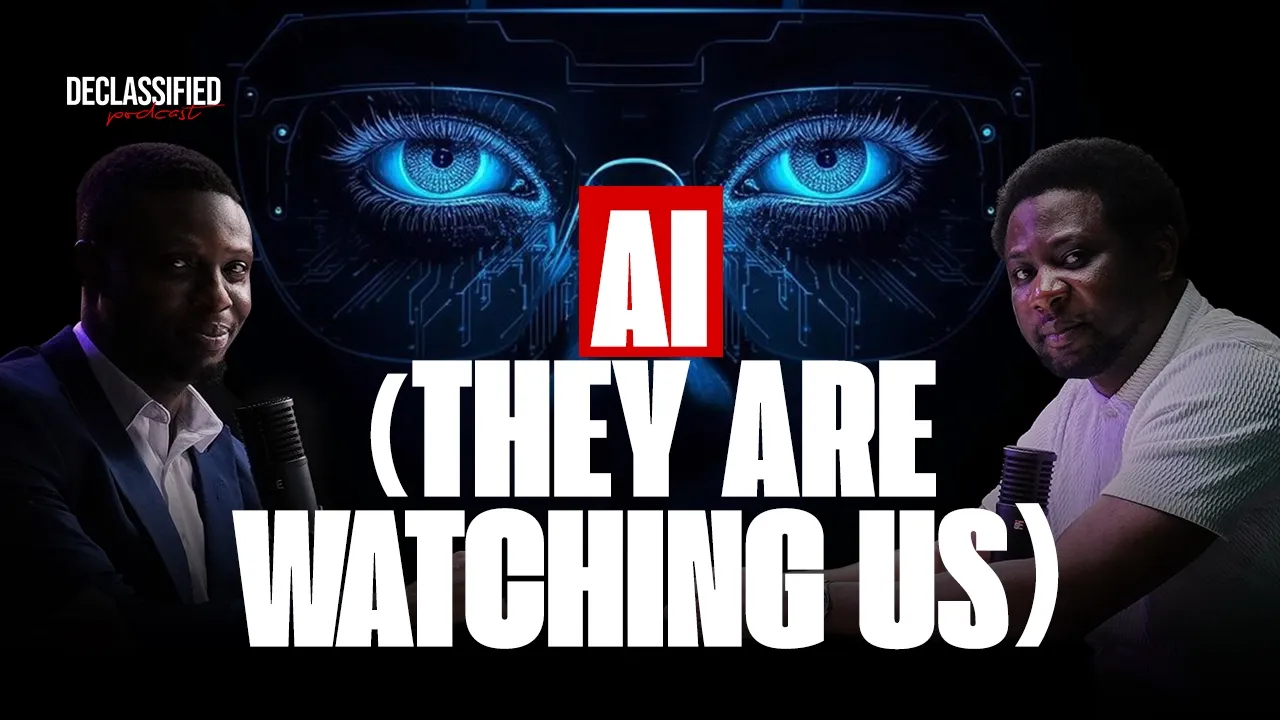
They Just Need To Convince The Masses They Have Hit It. They Don't Need To Actually Hit It.
Notes/Excerpt
These notes were taken while listening and may contain some errors. Please tap any sentence twice to suggest corrections.
By holding or selecting a paragraph, you can easily share snippets to friends or on your whatsapp status directly
The Disruption Technology Always Brings
Every useful piece of technology is meant to make certain things redundant. That is not a threat — it is how progress works. In the 1930s, mathematics teachers in the United States and United Kingdom were protesting against the use of calculators in high schools. That sounds absurd now. In 50 years, the AI of today will look like a calculator.
What is different about this moment is that for the first time, generative AI is able to seem like it is creating new things. Earlier forms of AI existed, but nothing that appeared to generate knowledge, images, and creative output the way current systems do. Geoffrey Hinton, considered one of the godfathers of AI, noted that it is now able to mimic human intuition — and then warned publicly about the risks.
The question is not whether AI will displace people. It will. The question is whether human intelligence will be upgraded fast enough to find better work to do.
The Biggest Lie About AI Right Now
The biggest lie being told about artificial intelligence is that it is smarter than it actually is — and it is deliberate. The companies driving AI development are afraid they may never reach Artificial General Intelligence (AGI). So they need the storytelling. They need people to believe they are close.
Since 2022, the drumbeat has been that AGI is imminent. Elon Musk predicted it by December 2025. Sam Altman made similar claims. Neither came to pass. Experts like Yann LeCun, former Chief AI Scientist at Meta, have consistently argued that the gap between current AI and true general intelligence remains enormous — and his reasons are technically sound. But those voices are drowned out because it is the masses, not the experts, who ultimately determine perception.
They just need to convince the masses they have hit it. They don't need to actually hit it.
The AI systems of today do what is called probabilistic pattern generation. They predict the next likely word, image, or output based on patterns in training data. That is not reasoning. It is not consciousness. It is a very sophisticated form of statistical completion.
The Causal Reasoning Breakthrough
One area where AI genuinely falls short is causal reasoning — the ability to reason from cause to effect based on the principles that govern a situation. If a chair breaks, a human being can differentiate between two possible causes: was it weight that broke it, or was it already structurally weak? AI currently cannot make that distinction reliably. It does not yet have intuitive knowledge of physics or the capacity to examine and interpret evidence in context.
This is the frontier where genuine progress toward AGI must be made — not generating text that sounds human, but reasoning that understands why things happen the way they do.
AI, Surveillance, and the Absence of Privacy
The devices people use daily — phones, smart TVs, laptops — are not neutral. Smart televisions with sensors can track eye movements. Phones listen to conversations. This is not speculation; there have been multiple verified lawsuits against major technology companies on precisely this point. The Jeffrey Epstein case brought this into sharp focus: a person who posted observations online about a suspicious vehicle near the facility was identified within hours by government subpoena of device data — and that person turned out to be an employee at the facility itself.
- Every phone tied to a SIM card is registered — and telecommunications companies operate under government licensing agreements that include data-sharing obligations
- Spy software like Pegasus, developed by Israeli intelligence, has been used by multiple governments to monitor their own citizens
- Social media platforms collect device-level data — IP addresses, device fingerprints, location — with or without a real name attached
- Between Apple and Samsung, Apple creates a false sense of security by marketing privacy while Android users, knowing the limitations, often take more protective measures
Nothing is safe. The person who knows this and takes precautions is in a better position than the person who trusts a brand.
The recommendation for those who want to protect sensitive information is to use an offline AI model — one with no internet connection — for important work, and for those who can afford it, a private home server that does not beam data anywhere externally.
Deep Fakes and the Collapse of Verifiable Truth
Deep fake technology has reached a point where the common person has no defense. A face can be lifted from a podcast, placed onto a body in a pornographic video, and circulated before any correction can catch up. Politicians have been falsely associated with compromising footage. Voices are being cloned.
In the Gaza conflict, media organizations attempting to verify images found themselves unable to definitively confirm or deny whether footage was real or AI-generated — while those videos were already accumulating millions of views on social media.
By the time the correction arrives, the narrative has already formed.
The only current defenses are discernment, specialized verification tools, and media literacy — none of which the average person has been equipped with.
What AI Is Doing to the Job Market
The jobs most at risk are not the ones people expect. The clearest predictor of displacement is this: any career path that gives no room for original research or knowledge creation is at risk. If the work can be done without generating something that has never existed before, AI will do it.
- Photography — AI can generate and place subjects in any environment with a prompt
- Video editing — facing displacement within 3 to 5 years at current trajectory
- Entry-level writing, graphic design, and video production — already largely replaced; mid-level roles are next
- Clinical medicine — among the most structured disciplines in the world, which paradoxically makes it one of the easiest for AI to take over; robots are already performing surgery
One of the most underappreciated consequences is the erasure of entry-level roles. This creates a structural problem: expertise is built through experience, and experience is built through entry-level work. Without entry-level positions, the pipeline to expertise is broken. People can no longer learn on the job because the jobs no longer exist at that level.
What Still Has Value
The fields with staying power share a common characteristic: they require original intelligence that cannot be scraped from existing data.
- Thought leadership — synthesizing expertise and communicating it in ways that are distinctive and unreplicable by pattern generation
- Fine art — people want to see what is original; they want artwork that is alive
- Domain-specific research — knowledge created in silos, not published online, that remains proprietary
- Problem-solving expertise — the ability to formulate problems, think creatively, and operate across disciplines
The practical advice is counterintuitive: in an age of AI, deliberately keep certain knowledge offline. Create information that has never been indexed. A private server, an offline model, handwritten notes — these are not regressions. They are protections.
Africa and the AI Race
Technology is the great leveler. It removes the need for permission to be great. A person who started coding on a phone can build and deploy a functioning application in minutes using current AI tools. The barrier to entry has never been lower.
And yet Africa is not running this race. The continent with the world's youngest population — which is, by definition, the future — is watching other regions set the terms of the next revolution, just as it watched the industrial revolutions before it.
The pattern has been consistent: disruption, recreation, control. Africa waits for the world to think, then buys what the world sells.
The nations that will lead tomorrow must take hold of AI now — and take hold of narrative now.
Nigeria alone has produced Africa's first tech unicorns. Its entertainment industry is winning awards globally without government support. The talent exists. What is missing is the infrastructure of belief, investment, and education that converts raw human capital into technical and intellectual leadership.
The recommendation is not for governments to sponsor influencers. It is for thought leaders — people whose reputation is staked on their field — to communicate their expertise publicly, independently, and rigorously. Their credibility is the guardrail. Science and law and craft still have to check out, regardless of who funds them.
Apostle Femi Lazarus
Enjoyed this sermon? Browse more messages by Apostle Femi Lazarus on ReadSermons.
Comments
0 comments
No comments yet. Be the first to share.
Stay updated with Readsermons
To be notified on every sermon release, join the group that suits you best:
For nuggets & Sharable snippets follow us.
headphones Media & Resources
Listen to Sermon
Download initiated! Follow us to be the first to get new sermons by Apostle Femi Lazarus.
Ai: They Are Watching Us
Apostle Femi Lazarus • 23MB
Download initiated! Follow us to be the first to get new sermons by Apostle Femi Lazarus.
Your download
is starting! 🎉
Connect with us directly for more powerful teachings.
Ai: They Are Watching Us
00:00:00 / 00:00:00